Best practice in implementing a coaching culture

Many of us across the Open Door Coaching Alumni are involved in introducing coaching into teams, business units and into our organisations with the view of creating a culture of coaching in the organisation.  Furthermore, a best practice approach is being adopted that is based on the Coaching Culture Framework, designed by Open Door.

For example, you can listen to the best practice implementation of the Coaching Culture Framework into Air Force.

First released in Bring Out Their Best over ten years ago, the Framework has had several iterations.  It is a feature of our Diploma of Organisational Coaching (10835NAT).  In addition, it was significantly updated back in 2010 and a part of our re-accreditation process with ASQA.

With this in mind, we thought it would be a great idea to introduce you to review the concept of coaching culture and introduce the framework.

Listen to the podcast of this coaching cafe

What is coaching culture?

In the early days of thinking about culture within organisations, we adopted the simple definition of culture being “the way we do things around here”.  In addition, we recognised that different departments, businesses and teams in an organisation can have similar or different cultures.  However, our thinking about culture and the influence of coaching on the culture of an organisation has matured. Importantly, we think of culture being more of an emergent property.  As a result, this means something that occurs over time. Furthermore, emerging from shared values, beliefs, assumptions, artefacts and rules about how to do things and what is important. And applicable across individuals, teams, divisions and organisations.

Defining coaching culture

Therefore, we see a culture of coaching emerging as: many people in the organisation use coaching techniques and principals, including strong listening and questioning skills to bring out the best in individuals and teams. Furthermore, coaching is a common way of engaging in conversations, rather that telling people what to do, giving advice, mentoring and other techniques.

Culture (shared values, beliefs, rules, artefacts etc)

+ Coaching Skills

= Coaching Culture

Notwithstanding, coaching is not the only technique or methodology used in the organisation.  In addition, it is not the only methodology or management/leadership tool appropriate in all situations. However, in a normal high performing individual, team or organisation the coaching principals and coaching tools are actively used.
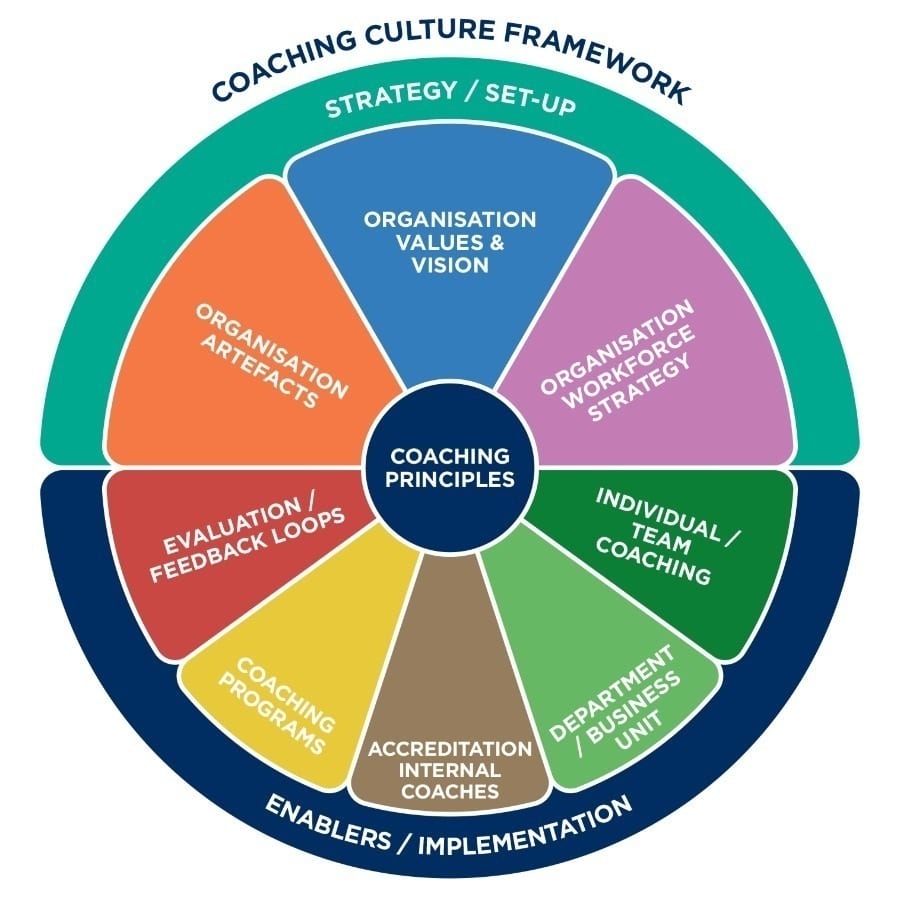
Coaching Culture Map

A framework for thinking about the culture of coaching

There are a number of elements that support the emergence of a coaching culture within an organisation.  We have captured these in the diagram below, called the Coaching Culture Framework.

The Coaching Culture Framework is split into two halves.  Firstly, the upper half being those elements related to the strategy of the organisation and the decisions needed to set up coaching within the organisation. Secondly, the lower half which relate to elements that enable the implementation of coaching in the organisation.  The middle element is a reminder that the coaching principles sit across all factors.

We use coaching techniques and tools to enable strategy

The implementation of coaching within an organisation is not a linear process. Alternatively, we each of the elements of the Coaching Culture Framework, interacting in a dynamic way.  This enables the achievement of the organisation vision, values and goals.  In addition, enabling the organisation workforce strategy (the upper half of the diagram).  At this point, there is an important distinction to make and that is that coaching culture is not necessarily the ultimate goal.  The goal of implementing coaching is to achieve the organisation values and vision.  Along with the goals described in the workforce strategy. We use coaching techniques and tools to enable the strategy.

Implementation of Coaching

At the same time, successful implementations of coaching within organisations have been enabled by the organisation workforce strategy and organisation artefacts. These documents explicitly state the desire and need to introduce coaching activities.  Furthermore, providing the mandate for the implementation of coaching in the organisation.  Consequently, the elements of the ‘lower half’ of the diagram, enable the ‘upper half’ and vice versa.

Each of the elements of the Coaching Culture Framework are explained in the following webinar.

FREE Coaching Cafe Webinar

Every week our team of experts present “Coaching Cafe” webinar with topics for Managers, Leaders, Business Owners, and everyone who wants to be a better workplace coach, leading their teams to higher productivity, better outcomes and a happier, healthier workplace.

Join us this Friday for FREE.   Register now.

WHAT OUR CLIENTS ARE SAYING

Using the ZOOM meeting worked really well including the breakout session.  A terrific and engaging course, I enjoyed it immensely.

I loved it! It gave me everything I was hoping for (confidence, a framework and many lenses to consider) and more!

It is an excellent program that can be adapted to any area of a workplace. It will assist me with all my communications with other people, delivered by a very passionate facilitator, easy to listen to, flexible and attentive to the class.  I am thoroughly energised by what I have learnt so far.

This is the best program I have ever participated in. The Friday webinars have been great to help me embed the information I have learned. I am really appreciative of everyone that works at Open Door Coaching and the care and effort they put into helping everyone that joins the program.

My workplace skills and capabilities have taken a very positive turn. Where I would get exhausted or overwhelmed by difficult work relationships, I now am equipped and confident to manage these relationships and use some of the models I have learned to get positive outcomes in our interactions.

I thought the online format via ZOOM worked well and for people outside of capital cities, it is a much more affordable and less disruptive way of undertaking the training.

The course has really enhanced and further developed my skillset. What a phenomenal four days for the Zoom face to face part of the course and amazing, quick turnaround on assessment of online modules.

I have confidence in my ability to coach others. My skills have grown significantly and I am so much more conscious of not responding to my team with solutions with a great toolkit to support me. This coaching course has changed my behaviour significantly and positively in my life. Where once I loved solving others problems I now love seeing others solve their own problems.

Great work, this course  is amazing and definitely supports me in my goals. I have always wanted to make a difference and found coaching to be more beneficial than mentoring to support an individual to take responsibility for their own development and to move forward in their goals.

Since starting the program, my work role has not changed, but I have developed as a leader in my ability to develop myself and others. I developed an ability to detect “below the line” thinking, and to develop narrative to move above the line. My listening and questioning skills have grown, and my ability to detect opportunities for growth in self and others.

I feel I have the skills to better lead, manage and coach people in the workplace. The communication skills I have learnt have assisted me in my communications and have improved my relationships at work and home. I thought the program was great. It was challenging and a lot of work. But in the end there were real and useful learning outcomes. I really enjoyed this course and got a lot out of it. It provided me the opportunity to grow personally (the most important output) and gave me some very useful coaching skills

I have grown in confidence and started the journey of becoming a coach. The course provided me with some excellent theory and practical components which have worked together well in helping me along the journey. I now have greater confidence and much better listening skills. I’ve learnt what active listening actually means.  The higher level of confidence has allowed me to develop my coaching skills at a faster than expected rate.

My approach to all personal and professional discussions and my confidence has grown with what I have learnt from the program. I truely believe this program has changed my approach to all I do. I believe I have enhanced my communication and how to read and interact with different personalities types, listening with purpose and communicating with intent to learn and grow others.

I can see the benefits and knowledge and skills in coaching and can see its benefits in self coaching, one on one coaching and team coaching as well as in everyday conversations and conflict resolution. The face to face program and online program is excellent. I have completed various vocational and post graduate study courses and this is the best so far. Natalie Ashdown is an inspirational coach and trainer. Her teaching methods are engaging and very effective. Brigitte Calvert always completes assessment reviews speedily and the feedback was excellent and assisted in the learning process.

I am now comfortable coaching. I see lots of opportunities and I have realised that I have many skills. I have a greater awareness of serving the higher needs of all within my interactions. I am much better at posing appropriate questions to foster internal reflection. I think it is an excellent program.

I’ve learned a lot about myself and how to conduct conversations and am now confident to be able to perform a coaching session and have enjoyed a new sense of learning since commencing the course.

The program enabled me to reflect upon and identify HOW I coach. Throughout the assignment work I revisited my other training guides and has reinforced what I already knew, and also refreshed my knowledge of my coach training. I have a greater awareness of the theory and techniques that I use in my coaching practice each day . My coaching is much more effective as I am spending more time on the issues below the surface which is providing greater value and benefit to my clients.

I am now confident in holding coaching conversations with people. Not only am I able to set up a coaching business, but also my listening skills have improved immensely. This helps me in my business and my sales calls.

I have new skills to use professionally and personally, particularly regarding active listening, powerful questioning and a range of excellent materials to draw upon and reflect upon.

My attitude towards leadership coaching has changed greatly. I used to “teach” leaders how to manage people but now I use coaching to develop leaders’ skills. Whenever staff or managers come to me with a question, problem or issue, instead of giving them the answers, I coach them by asking the “who”, “how” and “what” questions. I have coached staff and managers through performance reviews, career development and employee relations issues.

Totally loving using my new coaching skills in the workplace. Staff are delighted with how I am helping them to solve their own problems. Absolutely loved the course! Would recommend it.

I’ve definitely grown personally as I’ve learnt new communication skills. I’ve started employing those skills in everyday work situations. I’m leading the way for my unit in adopting a coaching culture.

The way I view things has changed from trying to provide answers to helping people find their own answers. I have improved my listening skills and allow space for other’s answers.

For a limited time you could be eligible for $2,200 towards any of our coaching programs

government funding

Stay Up to Date